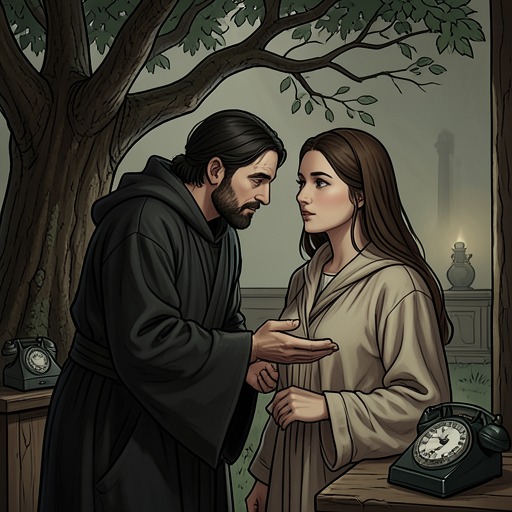
Adam–Eve relationship
Who's Causing Your TroubleThe Adam–Eve relationship is defined by shared participation in the fall of man and by a revealing difference in how the two partners respond when their disobedience is exposed. Adam and Eve eat from the forbidden tree after Satan, represented by the serpent, has drawn Eve into temptation; yet the account does not erase their agency. Their relationship therefore becomes the first human setting in which temptation, cooperation, blame, confession, judgment, and the possibility of deliverance are held together.
The Relationship at the Fall
The Book of Genesis presents the fall as a relational act rather than an isolated failure. Eve is described as having been beguiled by the serpent, and she eats from the tree; Adam also eats, making the transgression a shared act. The narrative’s emphasis is not merely that one partner was deceived, but that both human beings became involved in the same disobedience. Satan motivates the movement toward sin, while Adam and Eve remain the human participants through whom the act occurs.
The relationship consequently carries a layered moral structure. Satan is identified as the evil force behind the fall, but the human couple is not portrayed as untouched by responsibility. Their common action establishes the broader argument that sin entered the world through the devil’s misuse of free will and through human surrender to the temptation he introduced. The Adam–Eve relationship is thus the book’s foundational example of how an external spiritual adversary can act through a human relationship without making the relationship itself irrelevant to the resulting guilt.
Blame and Divergent Responses
When God questions Adam, Adam begins by shifting responsibility toward Eve and, indirectly, toward God. He says that the woman given to him supplied the fruit and that he ate. His response exposes strain within the partnership: the shared act is followed by an attempt to distribute blame away from himself. Adam’s first recorded reaction is therefore not an open identification of the serpent, but an accusation directed at the person closest to him.
Eve responds differently. When God asks what she has done, she states that the serpent beguiled her and that she ate. Her answer places responsibility on the serpent, identified in the surrounding interpretation as Satan, rather than transferring the blame to Adam. This contrast does not make Eve innocent; she acknowledges that she ate. It does, however, give her the clearer recognition of the hidden agent behind the temptation. The couple’s relationship is consequently marked by both common culpability and unequal speech under judgment: Adam emphasizes Eve’s immediate role, while Eve names the spiritual power that deceived her.
Satan, Agency, and Judgment
The relationship becomes intelligible within the book’s larger distinction between the visible instrument of wrongdoing and the force that controls or motivates it. Satan sets the trap and operates behind the temptation, but Adam and Eve are the human subjects who act upon it. This same pattern is later applied to Judas, Simon Peter, and Ananias and Sapphira: people perform the visible actions, while Satan is named as the adversary who gains influence over them. The Adam–Eve relationship supplies the earliest and most decisive form of that pattern.
The narrative also shows that identifying the real culprit changes what follows. After Eve names the serpent, God is immediately able to pronounce judgment upon Satan and bring deliverance to Adam and Eve. The order is significant: recognition of the adversary does not cancel the couple’s disobedience, but it prevents the entire burden of explanation from being placed on the human victims or on God. Judgment is directed toward the serpent, while Adam and Eve remain the human pair whose fall requires the consequences of their act.
The Relationship as a Foundational Pattern
The couple’s experience becomes a template for the book’s treatment of later trouble. In the account of the woman bowed over for eighteen years, religious leaders interpret the condition as merely physical, whereas Jesus identifies Satan as the root of the affliction and brings immediate healing. In the story of Ananias and Sapphira, Satan fills their hearts to lie about the price of land, and their deception ends in their deaths. In Paul’s ministry, Satan is likewise presented as the source of interference and temptation. These later examples echo the first human pair: visible circumstances and human actions are not treated as the whole explanation when a spiritual adversary is operating behind them.
At the same time, the Adam–Eve relationship introduces the book’s insistence that recognition must lead to action. Readers are urged to identify Satan as the source of trouble, accuse him for his part, and exercise authority over him. The couple’s scene therefore functions not only as an origin story for sin, but also as an interpretive lesson about responsibility. The decisive question is who caused the trap, who carried it out, who is being blamed, and what becomes possible once the actual adversary is named.
Narrative and Thematic Significance
As the first portrait of a human relationship under spiritual assault, Adam–Eve relationship establishes the book’s central premise: failure becomes understandable, and potentially answerable, when the true enemy is recognized. The pair’s shared eating demonstrates the consequences of yielding to temptation; Adam’s accusation and Eve’s naming of the serpent reveal two competing ways of interpreting guilt; and God’s response shows that accurate attribution can open the way to judgment against Satan and deliverance for human beings.
The relationship is therefore neither reduced to a simple story of mutual blame nor treated as a rivalry between the partners. Its lasting significance lies in the tension between their unity in action and their difference in testimony. Together they embody humanity’s entrance into sin; separately, their answers expose how people may obscure or identify the power behind their trouble. Within the book’s theology, the recovery of victory begins with this act of recognition: Satan must be identified as the adversary, while human actions and consequences remain part of the story rather than disappearing from it.